
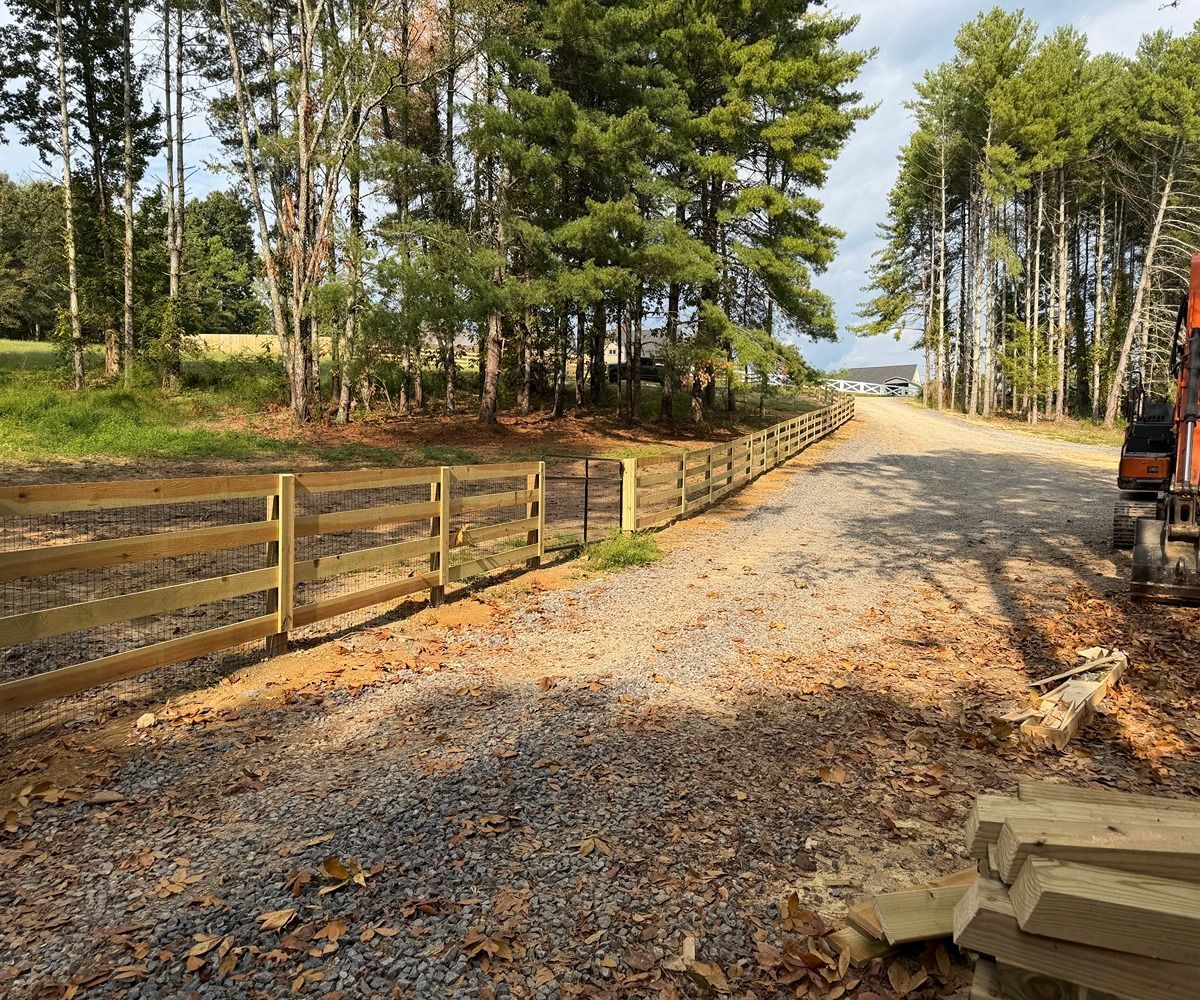
Fencing That Functions the Way It Should
Fence Repairs in Ooltewah for leaning posts, damaged panels, broken gates, and weather-related deterioration affecting security and appearance
A fence in visible disrepair communicates more than just maintenance neglect—leaning posts, missing boards, and gates that no longer latch create actual gaps in security, pet containment, and property definition. Ooltewah Decking Company handles fence repairs for residential properties where specific sections have failed while the overall fence line still holds structural value. Not every fence problem requires full replacement, and not every damaged fence can be saved with targeted repairs; the first step is an honest assessment of which category the fence falls into.
Southeast Tennessee's combination of clay-heavy soils, seasonal freeze-thaw cycles, and summer storm activity creates predictable failure patterns in residential fencing. Posts are the most common failure point—when the soil around a post base becomes saturated repeatedly, the post can shift laterally and lose its upright position. A leaning post that is still structurally sound at the base may be correctable by resetting it in new concrete, while a post that has rotted at the soil line needs to be replaced entirely before the panel it supports can be reattached properly. Panels that have been struck by falling limbs, damaged by a vehicle, or simply degraded through years of moisture exposure can often be swapped out individually without disturbing adjacent sections of the fence run.
Schedule a fence repair assessment to identify which sections require immediate attention and what the most cost-effective path forward looks like for your property.
What Fence Repairs Actually Accomplish
Effective fence repair starts with evaluating the fence's actual condition rather than immediately replacing the most visibly damaged section. A post that appears only slightly off-plumb at the top may have significant rot at the base, meaning a surface fix would fail again within a season. Conversely, a fence that looks weathered and gray on the surface may have structurally sound posts and rails underneath—a condition where board replacement and surface treatment extends the useful life considerably without the cost of a full installation.
After repairs are complete, the restored sections of the fence function consistently with the rest of the line—posts sit plumb, panels hold tension between posts without bowing, and gates close squarely on their hinges and engage the latch under normal hand pressure. Ooltewah Decking Company matches replacement boards to the existing fence profile where possible so repaired sections do not create a patchwork appearance along an otherwise consistent fence run.
Gate repairs deserve specific attention because gate failures are rarely just about the latch. Gates sag when the post they are hung on shifts, when hinge hardware corrodes and loses holding strength, or when the gate frame itself has racked out of square from repeated lateral force. Replacing only the latch hardware on a sagging gate addresses a symptom without correcting the structural cause. In Ooltewah's climate, hinge hardware selection also matters—exposed steel hardware corrodes faster in high-humidity conditions than galvanized or coated alternatives, which affects how long the repair holds before hardware replacement is needed again.
Answers to Frequent Fence Repair Questions
Homeowners dealing with fence damage often have questions about whether repairs will hold, what causes repeated failures, and how to distinguish a repairable fence from one that needs replacement.
How do I know whether my fence needs repairs or full replacement?
The condition of the posts is the deciding factor in most cases—if posts are structurally sound at the base, targeted panel and board repairs typically make sense. When multiple posts along the same fence run have rotted at the soil line, the cost difference between repeated repairs and a new installation narrows significantly.
Why do fence posts fail more often in some yards than others?
Post longevity is closely connected to soil drainage and post depth. In Ooltewah, yards with clay-heavy soil that holds water after rain create sustained moisture contact at the post base, which accelerates decay even in treated wood. Posts set at inadequate depth also shift more readily under the lateral pressure of wind loads during severe weather.
What causes a gate to sag or stop latching correctly?
Gate sag typically originates at the hinge post rather than the gate itself—when the post shifts, the gate hangs at an angle that prevents the latch from aligning. The fix involves correcting the post position before adjusting hinge placement, not just shimming the latch side.
When is the right time to schedule a fence repair assessment?
Addressing fence damage before a seasonal storm cycle begins is preferable to waiting, since compromised posts and panels absorb additional damage under high wind and debris impact. Visible leaning, loose boards at the base, or a gate that no longer self-closes are reliable indicators that an assessment is overdue.
What does a fence repair assessment include?
A repair assessment involves inspecting post condition at the soil line, checking panel attachment and board integrity, evaluating gate hardware and frame squareness, and identifying sections where deterioration is progressing but not yet visible on the surface. The outcome is a clear picture of what needs immediate attention versus what can be monitored.
Ooltewah Decking Company evaluates fence condition before recommending a repair scope, so homeowners understand exactly what work is being done and why. Call (423) 802-9491 to arrange an on-site assessment of your fence and discuss the repair options appropriate for its current condition.